
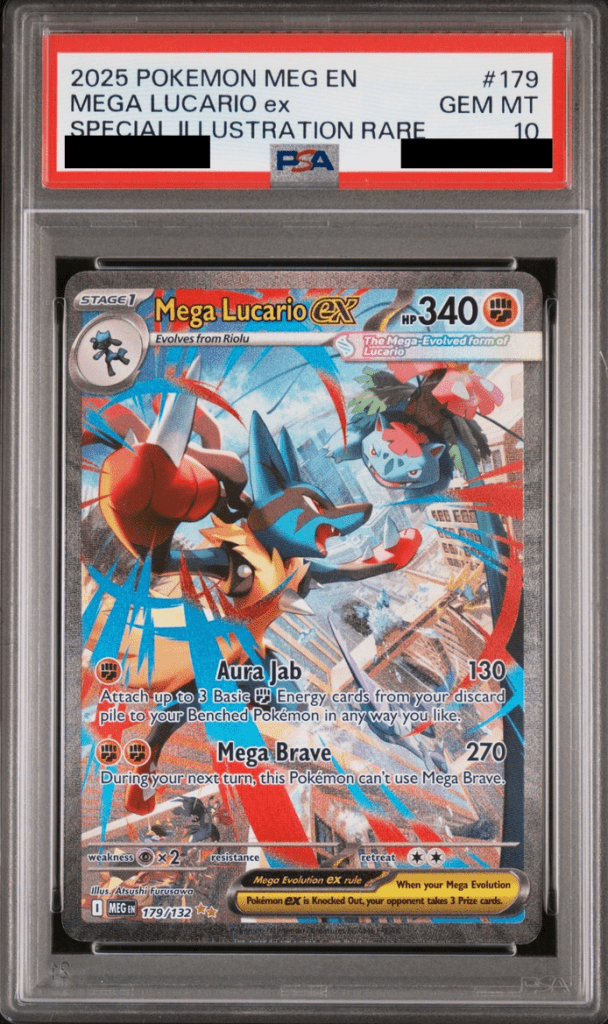
If you’ve been watching the ticker on Card Chill, you’ve noticed a bizarre divergence in the Pokemon market. The Mega Lucario ex Special Illustration Rare (SIR) has hit a “Stagnation Wall” in its raw form, hovering stubbornly between $150 and $160. Yet, in the same breath, the PSA 10 “Gem Mint” sales have detached from reality, tripling their multiplier to nearly $1,000+.
In the world of investing in pokemon, this is known as a “Quality Gap.” But in 2026, this isn’t just about condition—it’s a perfect storm of grading logistics, “Batching” defects, and the 30th Anniversary crunch.
1. The “Silver-Edge” Defect: Why 10s are Rarer Than Ever
The primary reason raw prices aren’t moving is that the market is flooded with “Near Mint” copies that have zero chance of hitting a 10.
Information Gain Play: Our recent reports from tcg guides confirm a recurring factory defect in the Ascended Heroes print run. Approximately 70% of Mega Lucario ex SIRs are coming out of the pack with “Micro-Chipping” on the bottom silver border.
To the naked eye, these Pokemon Cards look perfect. To a PSA grader with a 10x loupe, they are automatic 9s. This has created a “Pop Report” bottleneck. While the raw supply is high, the “Gem Mint” supply is practically non-existent. When supply for the highest grade is throttled but demand from high-end pokemon investments remains at an all-time high, the multiplier explodes.
2. The PSA “Price Hike” Barrier
As of February 10, 2026, PSA has officially eliminated its lowest bulk tiers, effectively raising the cost to grade a single card to $25.00.
This has discouraged the “Casual Grader.” Investors are no longer sending in every Lucario they pull; they are only sending in the absolute “top 1%” of copies. For Card Chill readers, this means the PSA 10s on the market today represent a much higher standard of scrutiny than 10s from two years ago.
Investors are paying a premium for the “New Label Confidence.” If you are investing in pokemon today, you aren’t just buying the card; you’re buying the fact that someone else risked a $25 fee and a 60-day wait on a card that was likely to come back as a 9.
3. The “Meta-Staple” Liquidity Trap
Mega Lucario ex isn’t just a pretty face; it’s a dominant force in the 2026 competitive circuit. Because players need the card for their decks, the raw supply is being “consumed” by players.
- Players buy Raw for $150 (they don’t care about a silver chip).
- Collectors buy PSA 10s for $1,000.
This splits the market in two. The top pokemon cards usually see their raw prices rise alongside their graded prices, but because Lucario is a “Player’s Card,” the raw price is tethered to its “Playability Value,” while the PSA 10 is tethered to its “Rarity Value.”
4. How to Play the Lucario “Spread”
If you are looking at pokemon tcg sets to flip, the “Raw-to-Graded” arbitrage is currently the most profitable play in the hobby.
- The Strategy: Buy “Mint” raw copies for $155.
- The Filter: Use a digital centering tool. If it’s not 60/40 or better, don’t buy it.
- The ROI: If you hit a 10, your investing in pokemon just turned $155 into $1,000. Even if you hit a 9, you likely break even or see a small 10% gain.
Check our top chase pokemon cards list daily. If the PSA 10 price starts to dip, the raw price will finally follow. Until then, the gap is your biggest opportunity.
Final Verdict: Don’t Buy the “Stagnant” Raw Hype
Don’t be fooled by the $150 price tag. The Mega Lucario ex is actually one of the most expensive Pokemon Cards in the world—it’s just that only 5% of the existing copies are “real” Lucarios in the eyes of the market.
For more tips on how to spot the 10s from the 9s, check out our latest pokemon guides on “Micro-Centering in the Mega Era.”
Are you still chasing the 10, or have you settled for a ‘Binder Mint’ 9? Join the debate on the r/CardChill Reddit!